|
All quotes are
taken from "Universalism: The Prevailing Doctrine"
Let's start with a 31 point summary...
The first clear and definite statement
of human destiny by any Christian writer after the days of the Apostles,
includes universal restoration, and that doctrine was advocated by most of the
greatest and best of the Christian Fathers for the first five hundred years of
the Christian Era. In one word, a careful study of the early history of the
Christian religion, will show that the doctrine of universal restoration was
least prevalent in the darkest, and prevailed most in the most enlightened, of
the earliest centuries--that it was the prevailing doctrine in the Primitive
Christian Church.
This the general sentiment in the church from 325 A.D. to
381 A.D. demanded that the life beyond the grave must be stated, and as there is
no hint of the existence of a world of torment, how can the conclusion be
escaped that Christian faith did not then include the thought of endless woe?
Would a council, composed even in part of believers in endless torment, permit a
Universalist to preside, and another to shape its creed, and not even attempt to
give expression to that idea? Is not the Nicene creed a witness, in what it does
not say, to the broader faith that must have been the religion of the century
that adopted it? It is historical (See Socrates's Ecclesiastical History) that
the four great General Councils held in the first four centuries--those at Nice,
Constantinople, Ephesus, and Chalcedon--gave expression to no condemnation of
universal restoration, though, as will be shown, the doctrine had been prevalent
all along.
The first Christians, it will be seen, said in
their creeds, "I believe in the aeonian life;" later, they modified the
phrase "aeonian life," to "the life of the coming aeon," showing that the
phrases are equivalent.
But not a word of endless
punishment. "The life of the age to come" was the first Christian creed, and
later, Origen himself declares his belief in aeonian punishment, and in æonian
life beyond. How, then, could aeonian punishment have been regarded as
endless?
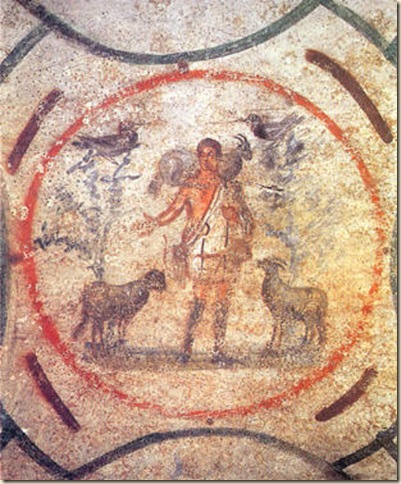
An illuminating side-light is cast on the opinions of the early Christians by the inscriptions andemblems on the monuments in the Roman Catacombs.12 It is well known that from the end of the Firstto the end of the Fourth Century the early Christians buried their dead, probably with the knowledgeand consent of the pagan authorities, in subterranean galleries excavated in the soft rock (tufa) thatunderlies Rome. These ancient cemeteries were first uncovered A.D. 1578. Already sixty excavationshave been made extending five hundred and eighty-seven miles. More than six, some estimates sayeight, million bodies are known to have been buried between A.D. 72 and A.D. 410. Eleven thousand epitaphs and inscriptions have been found; few dates are between A.D. 72 and 100; the most are fromA.D. 150 to A.D. 410. The galleries are from three to five feet wide and eight feet high, and the niches for bodies are five tiers deep, one above another, each silent tenant in a separate cell. At the entranceof each cell is a tile or slab of marble, once securely cemented and inscribed with name, epitaph, oremblem. Haweis beautifully says in his "Conquering Cross:" "The public life of the early Christianwas persecution above ground; his private life was prayer underground." The emblems and inscriptions are most suggestive. The principal device, scratched on slabs, carved on utensils and rings, and seen almost everywhere, is the Good Shepherd, surrounded by his flock and carrying a lamb. But most striking of all, he is found with a goat on his shoulder; which teaches us that even the wicked were at the early date regarded as the objects of the Savior's solicitude, after departing from this life.
We
find in the Catacombs neither the cross of the fifth and sixth centuries nor the
crucifixes of the twelfth, nor the torches and martyrdoms of the seventeenth,
nor the skeletons of the fifteenth, not the cypresses and death's heads of the
eighteenth. Instead of these the symbols of beauty, hope and peace." For example, the
Pharisees, according to Josephus, regarded the penalty of sin as torment without
end, and they stated the doctrine in unambiguous terms. They called it
eirgmos aidios
(eternal imprisonment) and timorion adialeipton
(endless torment), while our Lord called the punishment of
sin aionion kolasin (age-long chastisement). Philo adopts
athanaton, ateleuteton
or aidion to denote endless, and
aionian temporary duration. The word by which
our Lord describes punishment is the word
kolasin , which is thus defined:
"Chastisement, punishment." "The trimming of the luxuriant branches of a tree or
vine to improve it and make it fruitful." "The act of clipping or
pruning--restriction, restraint, reproof, check, chastisement." "The kind of
punishment which tends to the improvement of the criminal is what the Greek
philosopher called kolasis or
chastisement." "Pruning, checking, punishment, chastisement, correction." Now observe:
Christ carefully avoided the words in which his auditors expressed endless
punishment (
aidios, timoria
and adialeiptos ), and used terms they did
not use with that meaning (aionios
kolasis ), and employed the term which by universal consent among the
Jews has no such meaning (Gehenna); and
as his immediate followers and the earliest of the Fathers pursued exactly the
same course, is it not demonstrated that they intended to be understood as he
was understood? Classic scholars know that the heathen hell was early copied
by the Catholic church, and that almost its entire details afterwards entered
into the creeds of Catholic and Protestant churches up to a century ago. Any
reader may see this who will consult Pagan literature and writers on the opinions of
the ancients.
And not only this, but the heathen
writers declare that the doctrine was invented to awe and control the multitude.
Polybius writes: "Since the multitude is ever fickle there is no other way to
keep them in order but by fear of the invisible world; The Rev. T. B. Thayer, D. D., thinks
that the faith of the early Christian church "of the orthodox party was one-half
Christian, one-quarter Jewish, and one-quarter Pagan; while that of the gnostic
party was about one-quarter Christian and three-quarters philosophical
Paganism." The purpose of many of the fathers seems to have been to bridge the
abyss between Paganism and Christianity, and, for the sake of proselytes, to
tolerate Pagan doctrine. Says Merivale: In the Fifth Century, Paganism was
assimilated, not extirpated, and Christendom has suffered from it more or less
even since. That the Old Testament does not teach even post-mortem
punishment is universally conceded by scholars, as has been seen; and that the
Egyptians, and Greek and Roman Pagans did, is shown already. "Come all with me, as many as have died through the tree
which he touched, for behold I raise you all up through the tree of the cross.'"
This book shows conclusively that the Christians of that date did not regard
æonian punishment as interminable, inasmuch as those who had been sentenced to
that condition were released. The first of the apostolic fathers was
Clement of Rome, who was bishop A.D. 85. Eusebius and Origin thought he was
Paul's fellow laborer. His famous (first) epistle of fifty-nine chapters is
about the length of Mark's Gospel. He appeals to the destruction of the cities
of the plains to illustrate the divine punishment, but gives no hint of the idea
of endless woe, though he devotes three chapters to the resurrection. Theophilus and
Origen use similar language. He says: "Let us reflect how free from wrath he is
towards all his creatures." God "does good to all, but most abundantly to us who
have fled for refuge to his compassions," etc. God is "the all-merciful and
beneficent Father." Neander affirms that he had the Pauline spirit," with love
as the motive, and A. St. J. Chambre, D.D.,
2 thinks "he probably believed in the salvation of all men,"
and Allin3 refers to Rufinus and says, "from which
we may, I think, infer, that Clement, with other fathers, was a believer in the
larger hope." Irenæus says: "God drove Adam out of
Paradise, and removed him far from the tree of life, in compassion for him, that
he might not remain a transgressor always, and that the sin in which he was
involved might not be immortal, nor be without end and incurable. He prevented
further transgression by the interposition of death, and by causing sin to cease
by the dissolution of the flesh that man ceasing to live to sin, and dying to
it, might begin to live to God." These three sects were bitterly opposed by
the "orthodox" fathers in some of their tenets, but their Universalism was never
condemned. Mere Gnostics were only Pagan philosophers, but Christian Gnostics
were those who accepted Christ as the author of a new and divine revelation, and
interpreted it by those principles that had long antedated the religion of
Jesus.5
"The Gnostics were the first regular commentators on the New
Testament. The Gnostics were also the first practitioners of the higher
criticism. It (Gnosticism) may be regarded as a half-way house, through which
many Pagans,like Ambrosius or St. Augustine, found their way into the
church."Differing from the so-called
"orthodox" Christians on many points, the three great Gnostic sects of the
Second Century were in full agreement with Clement and Origen and the
Alexandrine school, and probably with the great majority of Christians, in their
views on human destiny. They taught the ultimate holiness and happiness of the
human family, and it is noteworthy that though all the Gnostics advocated the
final salvation of all souls, and though the orthodox fathers savagely attacked
them on many points,
they never reckoned their Universalism as a fault. This
doctrine was not obnoxious to either orthodox or heterodox in the early
centuries. As late as the Middle Ages the "Oracles" was well known, and its
author was ranked with David. The Universalism of Clement, Origen and their
successors must, beyond question, have been taught by their great predecessor,
Pantaenus, and there is every reason to believe that the Alexandrine school had
never known any contrary teaching, from its foundation. At this time Alexandria was the second city
in the world, with a population of 600,000; its great library contained from
400,000 to 700,000 volumes; at one time 14,000 students are said to have been
assembled; and it was the center of the world's learning, culture, thought; the
seekers for truth and knowledge from all climes sought inspiration at its
shrines, and it was most of all in its interest to us, not only the radiating
center of Christian influence, but its teachers and school made universal
salvation the theme of Christian teaching. Clement insists that punishment in Hades is remedial and restorative, and that punished souls are cleansed by fire. The fire is spiritual, purifying 13 the soul. "God's punishments are saving and disciplinary (in Hades) leading to conversion, and choosing rather the repentance than the death of the sinner, (Ezek. xviii, 23, 32; xxxiii: II, etc.,) and especially since souls, although darkened by passions, when released from their bodies, are able to perceive more clearly because of their being no longer obstructed by the paltry flesh." 14 He again defines
the important word kolasis
our Lord uses in Matt. xxv: 46, and shows how it differs from
the wholly different word timoria
used by Josephus and the Greek writers who believed in
irremediable suffering. He says: "He (God) chastises the disobedient, for
chastisement (kolasis ) is for the good and
advantage of him who is punished, for it is the amendment of one who resists; I
will not grant that he wishes to take vengeance. Vengeance
(timoria ) is a requital of evil sent
for the interest of the avenger. He (God) would not desire to avenge himself on
us who teaches us to pray for those who despitefully use us (Matt. v: 44).
15
Therefore the good God punishes for these three causes:
First, that he who is punished (paidenomenos ) may become better
than his former self; then that those who are capable of being saved by
examples may be drawn back, being admonished; and thirdly, that he who is
injured may not readily be despised, and be apt to receive injury. And
there are two methods of correction, the instructive and the punitive, 16
which we have called the
disciplinary." Alexander, Bishop of Jerusalem, wrote to
Origen on the death of Clement, says Eusebius, "for we know these blessed
fathers who have gone before us and with whom we shall shortly be, I mean
Pantænus, truly blessed and my master; and the sacred Clement, who was my master
and profitable to me." This passage would indicate the fraternity of feeling
between these three, and seems to show that Origen was followed as teacher in the
Alexandrine school by his pupil Heraclas, who in turn was succeeded by
Dionysius, another pupil, so that from Pantænus, to Clemens, Origen, Heraclas
and Dionysius, to Didymus, from say A.D. 160 to A.D. 390, more than two
centuries, the teaching in Alexandria, the very center of Christian learning,
was Universalistic. Crombie's translation (Ante-Nicene Library,
Edinburgh, 1872) thus renders Origen: "But as it is in mockery that Celsus says
we speak of 'God coming down like a torturer bearing fire' and thus compels us
unseasonably to investigate words of deeper meaning, we shall make a few
remarks. The divine Word says that our 'God is a consuming fire' and that 'He
draws rivers of fire before him;' nay, that he even entereth in as 'a refiner's
fire, and as a fuller's herb' to purify his own people. But when he is said to
be a 'consuming fire' we inquire what are the things which are appropriate to be
consumed by God. And we assert that they are wickedness and the works which
result from it, and which, being figuratively called 'wood, hay, stubble,' God
consumes as a fire. The wicked man, accordingly, is said to build up on the
previously laid foundation of reason, 'wood, and hay, and stubble.' If, then,
any one can show that these words were differently understood by the writer, and
can prove that the wicked man literally builds up 'wood, or hay, or stubble,' it
is evident that the fire must be understood to be material, and an object of
sense. But if, on the contrary, the works of the wicked man are spoken of
figuratively, under the names of 'wood, or hay, or stubble,' why does it not at
once occur (to inquire) in what sense the word 'fire' is to be taken, so that
'wood' of such a kind should be consumed? For the Scripture says: "The fire
shall try each man's work of what sort it is. If any man's work abide which he
hath built thereupon, he shall receive a reward. If any man's work be burned, he
shall suffer loss.' But what work can be spoken of in these words as being
'burned,' save all that result from wickedness?" Ag. Cels: IV. xiii; xciv. The
treatment experienced by Origen is one of the anomalies of history. The first
hostility to him, followed by his deposition and excommunication, A.D. 232, is
conceded to have been in consequence of his opposition to the Episcopal
tendencies of Bishop Demetrius, and the envy of the bishop. His Universalism was
not in question. Lardner says that he was "not expelled from Alexandria for
heresy, but for envy." Some of the
alleged errors of Origen were condemned, but his doctrine of universal
salvation, never. Methodius, who wrote A.D. 300; Pamphilus and Eusebius, A.D.
310;
Universalism: The
Prevailing Doctrine Eustathius, A.D. 380; Epiphanius, A.D. 376 and 394;
Theophilus, A.D. 400-404, and Jerome, A.D. 400; all give lists of Origen's
errors, but none name his Universalism among them. Besides, some of those
who condemned his errors were Universalists, at the school of Antioch. And many
who were opponents of Origenism were mentioned by Origen's enemies with honor
notwithstanding they were Universalists, as Clement of Alexandria, and Gregory
of Nyssa. Pamphilus, who was martyred A.D. 294, and Eusebius, in their lost Apology for Origen, which is mentioned by at least two writers who had seen it, gave many testimonies of fathers preceding Origen, favoring Universalism,5 and Domitian, Bishop of Ancyra, complains that those who condemn the restorationism of Origen "anathematize all those saints who preceded and followed him," implying the general prevalence of Universalism before and after the days of Origen. in the year 544, this doctrine was for the first time
condemned and anathematized as heretical. From and after this point (A.D. 553)
the doctrine of eternal punishment reigned with undisputed sway during the
Middle Ages that preceded the Reformation. From these facts it is easily seen that the heresies of which
Origen was accused did not touch the doctrine of universal restoration. They
were for teaching inequality between the persons of the Trinity, the
pre-existence of the human soul, denying the resurrection of the body, affirming
that wicked angels will not suffer endless punishment, and that all souls will
be absorbed into the Infinite Fountain whence they sprang, like drops falling
into the sea. Epiphanius, a narrow-minded, credulous,
violent-tempered, but sincere man, A.D. 310-404, was bishop of Constantia in
Cyprus, A.D. 367. He bitterly opposed Origen, and denounced him for a multitude
of errors, but he does not hint that his views of restoration were objectionable
to himself, or to the church, at the time he wrote. Theodore of Mopsuestia was born in Antioch, A.D. 350,
and died 428 or 429. 'The first man was
of the earth earthly, the second man is the Lord from heaven,' that is, who is
to appear hereafter thence, that he may restore all to the likeness of himself."
"God knew that men would sin in all ways, but permitted this
result to come to pass, knowing that it would ultimately be for their
advantage. It may be mentioned that though Origen and
Theodore were Universalists, they reached their conclusions by different
processes. Origen exalted the freedom of the will,
Gregory Nyssen.
The Council of Constantinople, A.D. 381, which perfected
the Nicene Creed, was participated in by the two Gregorys; Gregory Nazianzen
presided and Gregory Nyssen added the clauses to the Nicene creed that are in
italics on a previous page in this volume. They were both Universalists. Would
any council, in ancient or modern times, composed of believers in endless
punishment, select an avowed Universalist to preside over its deliberations, and
guide its "doctrinal transactions?" And can anyone consistently think that
Gregory's Universalism was unacceptable to the great council over which he
presided?"
"From the time of Constantine," says Schaff, "church
discipline declines; the whole Roman world having become nominally Christian,
and the host of hypocritical professors multiplying beyond all control." It was
during Constantine's reign that, among other foreign corruptions, monasticism
came into Christianity, from the Hindoo religions and other sources, and gave
rise to those ascetic organizations so foreign to the spirit of the author of
our religion, and so productive of error and evil.
He says he "hates Greek," and the "grammar learning
of the Greeks." it is anomalous in the history of criticism that generations of
scholars should take their cue in a matter of Greek definition from one who
admits that he had "learned almost nothing of Greek," and was "not competent to
read and understand" the language, and reject the position held by those who
were born Greeks! That such a man should contradict and subvert the teachings of
such men as Clement, Origen, the Gregories and others whose mother-tongue was
Greek, is passing strange. But his powerful influence, aided by civil arm,
established his doctrine till it came to rule the centuries. Augustine Less Severe Than Modern Orthodoxy. Augustine,
however, held the penalties of sin in a much milder form than do his degenerate
theological descendants in modern times. He teaches that the lost still retain
goodness,--too valuable to be destroyed, and on that account the worst are not
in absolute evil, but only in a lower degree of good. "Grief for lost good in a
state of punishment is a witness of a good nature. For he who grieves for the
lost peace for his nature, grieves for it by means of some remains of peace, by
which it is caused that nature should be friendly to itself." He taught that
while unbaptized children must be damned in a Gehenna of fire, their torments
would be light (
levissima ) compared with the torment
of other sinners, and that their condition would be far preferable to
non-existence, and so on the whole a blessing. In a
limbus infantum they would only receive a
mitissima damnatio. Thus, says Schaff, "the Roman state, with its laws, institutions, and usages, was still deeply rooted in heathenism. The Christianizing of the state amounted therefore to a paganizing and secularizing of the church. The
synod voted fifteen canons, not one of which condemns universal restoration. Justinian not only commanded the council to suppress Universalism, but he arbitrarily closed the schools in Athens, Alexandria and Antioch, and drove out the great church centers of theological science that had been its glory. He had "brought the whole empire under his sway and he wished in like manner to settle finally the law and the dogmatics of the empire." To accomplish this evil work he found an aid in Rome, in a "characterless Pope (Vigilius) who, in gratifying the emperor covered himself with disgrace, and jeopardized his position in the Occident." But he succeeded in inaugurating measures that extinguished the broad faith of the greatest fathers of the church. "Henceforth," says Harnack, "there was no longer a theological science going back to first principles." |